Defining a Data Team
I’ve asked these questions and seen them asked on Reddit numerous times.
At networking events, or when I’ve worked with contacts across dozens of companies, I’ve probed a bit and dug around to try to understand how it’s handled there.
Moreover, I’m centrally involved in navigating this within my current company, as we grow and expand and the company and its data requirements evolve.
What roles make up your data team?
What is the optimal structure of your data team?
Where do your data/data science team(s) sit within your company?
… I know; quite the interrogation.
We live in a time when using data to drive decision-making is critical, and not maximising its impact is basically leaving money on the table. As such, how you structure and position your data capability can make a significant difference!
Over the next couple of posts I’ll outline what I’ve learned from reading around and talking with connections; but - as you will probably already know - there is no single answer that will definitively work. Multiple factors come into play, from type of business, stage of business growth, size of business, and maybe a couple more.
I share my thoughts below, by first addressing a core question …
What does a data team do?
The number of potential answers here scales approximately as:
\[\text{N}_{ops} \propto \sum_{i=1}^{n} \text{Businesses}_i \times \sum_{i=1}^{n} \text{CXOs}_i\]Where:
- Businesses is the number of distinct businesses, business units, departments, or initiatives.
- CXOs is the number of people in leadership or SLT roles in each unit.
- And “N” is a chaotic, ever-growing scalar quantity.
In English? Pretty much everyone is going to have an opinion; if they overlap, you’re golden
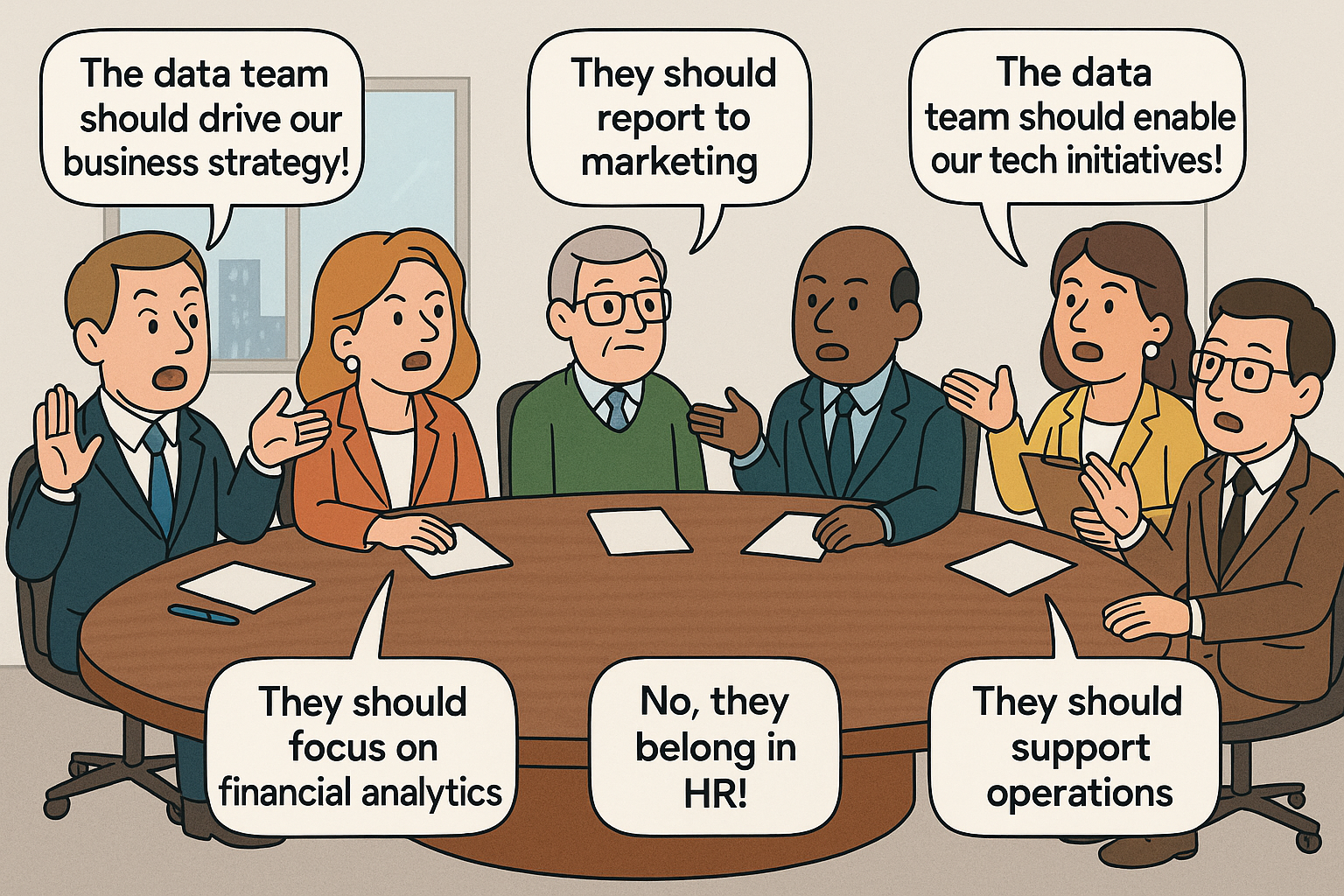
For me, a data team exists to structure, organise, manage and use the data collected by a company, to derive insights, enable, and provide value to the business.
This helps us understand some key roles that could constitute a data team…
Storing and structuring data requires some data and database engineers, and managing, controlling & monitoring these systems could involve a dedicated database administrator .
Ensuring security and compliance are key requirements for businesses - especially in the UK/Europe with the GDPR regulations. Database and system administrators, working with IT and legal teams, should be well versed in how to optimise their data infrastructure and documentation to enforce role-based data access and permissions, myriad process controls that allow conformation with various standards e.g. ISO27001; transparency and auditability is often a neccesity for certain potential customers, so the data team can provide huge value here.
Capturing data will likely be done by software; either be off-the-shelf or perhaps something developed internally; a bespoke solution. This could be a simple script which parses automatically generated files, or a full blow web app which interfaces with other systems This would involve some capacity of software developers, but also data engineers.
Enabling Access, including via Self-Service Analytics is more and more a key objective of the data team, allowing wider teams to interrogate and analyse the data in a safe and simple environment. This capability, developed by data analysts and data engineers working together perhaps with business analysts unburdens the data team from the day-to-day, tactical requirements, allowing data analysts and data scientists to focus on the strategic projects, with greater value-add.
Driving Insight and supporting decisions are a core function for data analysts, addressing issues and questions from product and finance teams, as well as working with domain experts to support technical teams. Outputs from these tasks can often inspire development of data products.
Building and deployment of Data Products such as forecasting models, classifier systems, recommendation engines etc etc., will be one of the more visibile and headline-making outputs of a well-established data team, primarily owned and developed by data scientists and ML engineers.
Strategic roadmapping to understand how ‘data’ will be best leveraged to support and enable the wider business requirements and strategy. For this to be successful, and allow the company to extract the most value from its data, data team leaders (Directors, Snr Managers, VPs, a CIO… - whatever) need to be integrated with the SLT and CXO. Data literacy where key decisions are made and strategies signed-off is crucial.
In my next post I’ll discuss the possible structures and positions for a data team. Thanks for reading 👍